
Categories
Client

5 Tips for Running Australian Public Service Interviews

As a panel member involved in an Australian Public Service (APS) recruitment process it’s important to get the most out of the interviews. Conducting interviews with fairness, transparency and adherence to the APS values is vital to find the best candidates for your organization. Here are 5 things to consider when running your next APS interview process.


Prepare Structured Questions

Develop a set of well-structured questions that align with the position requirements and the APS values. This ensures a fair and consistent interview process.


Assess APS Values Alignment

Include questions that assess how well the candidates’ values align with the APS values of Impartiality, Commitment to Service, Accountability, Respect and Ethical Behaviour.


Behavioural-based Questions

Use behavioural-based questions to gauge candidates’ past experience and actions in relevant situations, as these can provide insights into their potential future behaviour and performance


Diversity and Inclusion

Ensure that your interview panel consists of diverse members to avoid bias and promote inclusivity. Also consider incorporating questions that assess candidates’ commitment to diversity and inclusion.


Scoring and Feedback

Develop a scoring system to objectively evaluate candidates’ responses, and as a panel work together to achieve a consensus on each candidate’s performance. Also be prepared to provide constructive feedback to unsuccessful candidates to help them improve for future opportunities.


For assistance running your next APS recruitment process, please don’t hesitate to contact us on 02 6103 7000 or email hello@cbrrecruitment.com.au.

Categories
Candidate

3 Things to Remember When Writing Your APS Job Application

Writing a job application (sometimes known as a “pitch” or an “expression of interest”) for the Australian Public Service can seem daunting at first. It might seem like there’s no way you can write the amount they are asking for about yourself, or alternatively if you have had a long career you might think that you need to write more. Luckily, there are some great tricks, and we have summarised the key points from one of our public service job application training courses below, which will help you structure and plan your application so all you have to do is focus on the details!

The Position Requirements

The first thing you’ll want to look at when writing your application is the job ad / position information pack itself. Take note of the responsibilities and duties listed, as well as what they list as their ideal candidate.

Often, the qualities of their ideal candidate will align closely with the Integrated Leadership System (ILS) criteria relevant to the role you’re applying for. This means you can speak directly to their ideal capabilities by articulating your experience and skills against the ILS criteria and the capabilities listed.

You will need to prove you are capable of carrying out those responsibilities and providing evidence of this by providing relevant examples. Do this well and there is a strong chance you will be their ideal candidate.

Formatting

You might be surprised that the format of your application can be just as important as the content. If your application is poorly formatted, this makes it more difficult for the Panel to understand you and less likely to read your entire application. Panels also play very close attention to your spelling and grammar.

Using a simple format that is structured toward the role responsibilities or skills can help the Panel easily navigate your application. This also means you need to avoid using any pictures or fancy formatting, which can often lead to you missing out on extra written content. These can also be reproduced unpredictably within in departmental recruitment systems. Be aware that providing an application that is too short is just as bad as one that is too long.

Content

When it comes time to get down into writing, keep in mind what level you need to be speaking to. Have your ILS criteria handy, and make sure you’re proving that you both think and act at the right level. Dedicate some examples to demonstrate how suitable you are for the role.

Just stating you’re capable won’t cut it. You’ll have to prove it with clear descriptions of how you approached a specific situation and achieved an outcome.

The Australian Public Service often uses specific words and jargon, such as “communicates with influence”, some of which will be included in the position information or selection criteria. Use these words so you are “speaking the same language” as the Panel. Don’t go too overboard with them as your application may come across as not having substance. Use them where they are needed, particularly when stating you are capable of meeting the mark.

While writing your application may seem impossible before you get started, these tips should help. Add some unique experience, and the right level of enthusiasm, and you’re on the right track to create a winning application!

If you’re looking for help writing your application, we’re available to help. Get in touch with us at hello@cbrrecruitment.com.au to get started.

Categories
Candidate

Video Interviews and Where to Start

You have a video interview; what do you do?

Every interview comes with nerves and indecision, and some might not even be able to show up when the time comes. You could let your worries build until you become frantic, struggling to focus on what’s important. Or you could read these tips and tricks to ace that interview. Do you have what it takes when it comes down to you and your prep skills?

With video interviews becoming more common, it’s normal to have some questions. You might be asking, where do I start? Will they really know if I’m wearing pyjamas from the waist down? We’ll try and answer these for you today and give you some strategies to ensure you do your best.

Do Your Research

Before you even think about how fashionable you should be for your interview, you need to do some research. This is helpful even before you’ve received your gold star and been asked to come in for an interview.

Research the organisation and look into their corporate values and other relevant information such as their organisational structure, and their annual report as this will give you additional contextual information about who they are and what they do.

Read up on the role and job description, take notes on the requirements and consider how your skills and experience apply to the role. Look back at your resume and compare the two; what can you bring to the role that they’re looking for?

Write up some questions you think you could be asked and take notes on how to answer them. Try using this Practice Interview Builder and get comfortable in a conversation with yourself. Try practising those questions in a camera, record them to see if you would hire you.

Test your Technology

In the days before your interview, figure out what program or app you’re using. If you don’t know yet, it never hurts to contact the contact officer. Make sure your username is professional; the chances of Flamer123 being recruited aren’t very high.

Video calls can be done on laptops, phones, or tablets, so if you feel more comfortable with one than the other, feel free to use it; make sure your picture is clear and steady. Don’t forget to keep them charged!

Try calling a friend with your preferred device to make sure they can see and hear you clearly. There’s nothing good about a broken microphone or a cracked lens.

Pick Your Location

Before you sit down, make sure your camera can see clearly. You don’t want it to be too sunny or too dark. Make sure it’s quiet, too. Try to keep the dogs barking and cars honking to a minimum. If you don’t live alone, just let your housemates know you need the space. Remember to check your background and ensure it isn’t distracting or embarrassing. You want your potential future employer to remember you in your interview, not your fun cardboard cut-out of your favourite artist.

Dress to Impress

One of the most important aspects of an interview is your outfit choice. Though it seems superficial, it shows the interviewer that you’re taking this seriously and could jump straight into the job if they wanted you to. Being able to show you’ll blend seamlessly into their team is a big green flag.

Find something professional in your wardrobe, and make sure you’re dressed from head to toe. Not only will you feel more confident, but they also won’t have to see your panda pyjamas if you accidentally stand up.

In the Interview

The day has come. You’re 15 minutes early, waiting in your chosen location, fully charged, and looking great with your notes and pen on the side. Grab a glass of water, and take some deep breaths. Maybe do a meditation if you have time.

When it comes time for the interview, make sure you’re not reading off your notes. They’re handy if you get particularly stuck, but you want to be looking at the camera the whole time. This will help you appear to be making eye contact, and the employer will feel like you’re engaging with them. Sitting up straight and nodding along will also help them know you’re listening.

If you get a question that’s a little bit hard, don’t panic. Take a breath, and don’t be afraid to voice that you’re thinking of a good answer. Sometimes, you can even ask if they could return to it, and you can prepare while you move on.

Try not to interrupt the speaker, video interviews are often delayed, and they might not seem like they have more to say until you’re talking over each other. Take your time and give it a second longer before you start speaking.

End your interview with thanks, and make sure you close it on a positive note. Take a breath and relax. If you want to take an extra step to keep their eyes on you, try sending them an email of appreciation for the interview.


It’s normal to feel anxious before your video interview, but following these tips will help you to master those nerves. Practice, prepare, breathe into your confidence, and you’ll do great.


Categories
Candidate

How to Interview like a Super STAR!

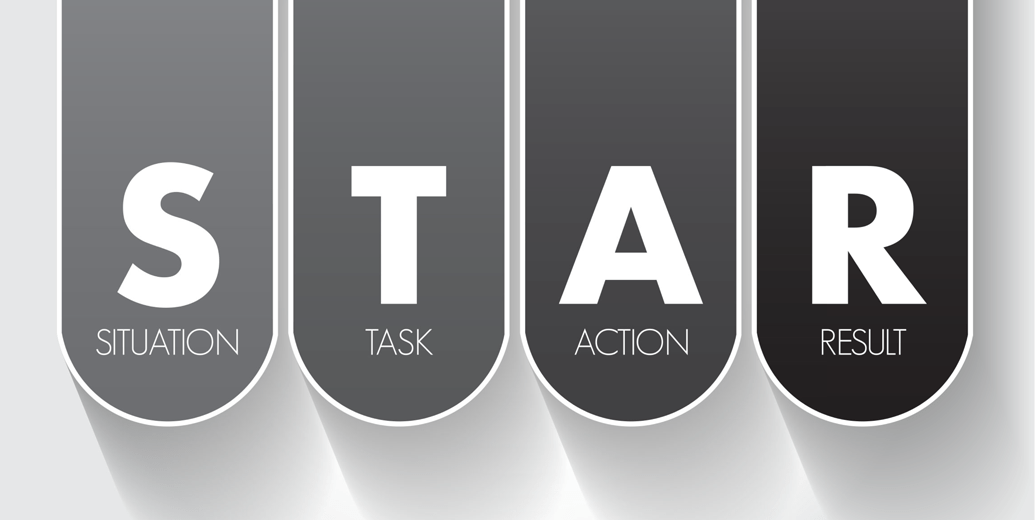
Using the STAR methodology can be an effective way of answering competency-based interview questions, and from our experience using it to frame your answers in public service interviews is a must! The idea behind the STAR methodology is that you talk about a specific example, give a good amount of context, and then really focus on finishing off by showing that what you did achieved a really positive outcome. So let’s break it down:

STAR is an acronym for Situation, Task, Action and Result


Situation

Set the context by describing a relevant situation where you applied your skills/qualities and gained your experience. It is important that you describe a specific event or situation not a generalised description. The situation that you discuss should be from a previous professional position. This is about framing your example and giving the interviews the context of the situation – try to be as specific as possible.


Task

What was YOUR specific role / job / responsibility? Describe your responsibility in the situation and what goal were you working towards to achieve.


Action

What did you do and how did you do it? Describe the steps and actions you took to address the situation. Use “I” not “we” when describing actions and be conscious that you don’t describe what the team did, keep the focus on you.


Result

Outline the result that stemmed from the actions you took. It is important that you think about how the result relates to the job you are applying for. Don’t be shy, take credit for your work and ensure your answer contains a really positive result. Even if you are talking about a difficult situation, sometimes how you overcame adversity can be a great result!


An Example Question and Answer using the STAR Methodology in an interview

Question: Can you give an example of a time when you had to clarify the needs of a stakeholder, colleague or manager? (supports productive working relationships)

Situation

Currently I work in the Business Improvement Team and we work as part of a larger division which is geographically dispersed across a range of locations so we don’t see each other face-to-face.

Task

There was a time when I had to do quite a bit of work with one of the managers of one of the teams that works alongside our team. We had to work together on important emergency management issues, however this manager began frequently calling me to ask me to do tasks that were well outside the responsibility of my role.

Action

While I was initially happy to help it began to have an impact on my own work outputs and priorities. I came up with a strategy to manage the situation where, when the manager would ask me to do a task, I would tell them the other priorities that I had for the day, which gave them an understanding of my workload and the situation improved significantly without developing into a conflict. I also kept my supervisor in the loop.

Result

The outcome ended up being really positive all round, as it turned out the manager didn’t have a good understanding of my workload due to the remote working arrangements.


CBR Recruitment can provide guidance on how to use the STAR methodology to blitz your next job interview, so please give us a call on 02 6103 7000 or email: hello@cbrrecruitment.com.au

For an in-depth guide on “Competency-based Interviews” please refer to our blog Competency Based Interviewing – What is it and why use it?


Categories
Client

How To Answer Those “Tricky” Interview Questions

The interview is one of the most important aspects of getting a job, and making a good impression is vital to your chances. Effective employment interviewing involves preparation and practice and to be prepared for an interview you need to acquire knowledge about yourself, about the job, and about the employer you are interested in working for. The following are various techniques that can help you make a good interview impression and answer those “tricky” questions.


Research the Organisation and the Position

The more you know about the organisation and the job you are applying for, the better you will appear in the interview. An interviewer will be impressed by your interest and motivation, and you will be able to explain what you can do for the organisation.

You should find out the following information before your interview:

  • The typical duties and salary range for the job in which you are interested;
  • The background of the organisation;
  • The products or services of the organisation;
  • The philosophy and values of the organisation; and
  • Any recent news regarding the organisation.
  • The likely format interview and whether questions will be competency-based or unstructured.

Prepare

Whether the interview is competency-based or unstructured, an interviewer must secure answers to four basic questions, either directly or indirectly through other questions and comments. You should be clear about your thoughts and prepared to give articulate answers to these questions:

  1. Why do you want to join the organisation?
  2. How much experience do you have in this area?
  3. How do your skills and values fit with the organisation?
  4. What are your salary requirements?


Handling Difficult Questions

If you are unsure about a question politely ask for the question to be repeated or for more information and write the question down if you need to. It is always better to understand the question than try and answer one that you don’t. Take your time with your answer and think about what you are saying. Never rush questions as you might miss out on saying what you wanted, and if you’re not sure you have answered the question completely, ask the interviewer if they would like you to elaborate. The best way to handle difficult questions in an employment interview is in an honest, positive manner. Some difficult questions employers ask include:

‘Tell me about yourself….’

The employer wants to gain information about your work experience, not your personal life. Talk about experiences and goals that relate to the specific job you are applying for.

‘How would you describe yourself?’

Discuss positive, work-related attitudes. For example, you could suggest that you enjoy working with people of all ages, are loyal, committed, etc.

‘Have you done this type of work before?’

Link the skills you possess to the abilities needed for the job. Answer truthfully about how your experience relates to the position.

‘Why did you leave your last job?’

Be honest, professional and positive in your response – interviewers need to be able to understand your reasoning for leaving past positions. Avoid any statements that may say something negative about yourself, your work, or your ability to get along with others.

‘You seem to be overqualified for this position. Why do you want this job?’

The employer may be questioning your goals or challenging your long-term commitment to the job. Indicate your sincere interest in working for the organisation. Emphasise the unique attitudes, abilities and interests that led you to apply for this job.


Ask Questions

You should conclude the interview with questions you have about the job. Make sure you are prepared with some questions you would like answered in the job interview. Apart from frequently-used question regarding the timing of the recruitment decision, if possible use this opportunity to engage with the interviewer about the team or organizational goals, or their expected achievements of the candidate within say the first 100 days of the role. This prompts them to tell you exactly what they expect.


After the Interview

End the interview with a handshake or warm farewell, (taking into account COVID-19 and social distancing protocols) and thank the interviewer for their time. Reiterate your interest in the position and your qualifications. Follow up with a phone call if you are not contacted within a week of when the interviewer indicated you would be.


The CBR Recruitment Team prides itself on doing our absolute best to prepare you for your interview so you have the best opportunity of winning your next job. To discuss your next career move, please phone: 02 6103 7000 or email: hello@CBRrecruitment.com.au

Categories
Client

Competency Based Interviewing – What is it and why use it?

The current industry leading practice is to interview candidates using a technique known as “Competency Based Interviewing” (also called “structured” or “behavioural” interviewing). Competency based interviewing is based upon the concept of linking three parameters – knowledge, skills and attitude. Each question is designed to test one or more specific skills and the answer is then matched against pre-decided criteria and marked or rated accordingly. For example, the interviewer may want to test the candidate’s ability to deal with stress by firstly asking how the candidate generally handles stress and then asking the candidate to provide an example of a situation where he or she worked under pressure.


How is Competency Base Interviewing Different?

Competency based interviewing differs from traditional interviewing (also called unstructured interviewing) as traditional interviews are essentially a conversation where the interviewer asks a number of questions that are relevant to what they are looking for, but without any specific aim in mind other than getting an overall impression of the candidate as an individual. Questions are usually quite random and can also be quite open. For example, a question such as “What can you offer our company?” is meant to gather general information about the candidate but does not test any specific skill or competency. In an unstructured interview, the candidate is judged on the general impression that he or she leaves and the process is therefore likely to be more subjective.


What are the Benefits?

Competency based interviews are more systematic, with each question targeting a specific skill or competency. Candidates are asked questions relating to their behaviour in specific circumstances, which they then need to back up with concrete examples. The interviewer will then dig further into the examples by asking for specific explanations about the candidate’s behaviour or skills.


An example of a competency-based interview question is:

“This is a busy role which manages high volumes of client contact and juggles a number of competing priorities. Can you tell us about a time when you have had to coordinate multiple work outputs with competing deadlines? What strategies did you employ and what was the outcome?”


This question tests organisational skills, working at a fast pace, dealing with stressful situations, providing high quality client service and achieving results.


Utilising Methodology

The “STAR” methodology can be useful tool to frame competency-based interview questions.


Situation

Ask the candidate to set the context by describing the circumstance where they used the skills or qualities you are seeking.

Task

What was their role / involvement in the situation?

Actions

What did they do and how did they do it?

Results

What did they achieve? What was the outcome of their actions?


Regardless of the specific position being recruited it is always worthwhile asking a question about communication skills, teamwork and organisational skills as these qualities are important requirements of most jobs.


Secondary Interviews

Another effective technique in assisting to select the best candidate for the position is to conduct a secondary interview with the top one or two candidates. This interview should be a much less formal unstructured interview – at a café for example. This is a good opportunity to meet the candidate in a less stressful environment than the initial interview, and will give you an excellent insight into their potential fit into the culture of your organisation, and you should be able to effectively gauge how you would work with the candidate on a day-to-day basis.


For assistance with your next recruitment campaign or with developing competency-based interview questions, please call CBR Recruitment on 02 6103 7000 or email: hello@CBRrecruitment.com.au

Categories
Client

5 Key Recruitment Tips for Small Business Owners – How to achieve the “perfect fit”.

Almost every small business owner I speak to says that recruiting and retaining high quality staff for their business is one of their biggest challenges. Recruiting staff is certainly a big step – wages are an expensive overhead, and the difference between an excellent staff member and a substandard staff member can have a profound impact on the overall performance of your business.

We look at recruiting staff as being an investment in your business – an opportunity to grow, to increase performance, and to provide your stakeholders with a better service or experience. Before we even start to consider “fit” there are several important steps in any recruitment campaign that need to be undertaken.

Firstly run a formal recruitment process – including at least first and second round interviews. Secondly ensure that the person actually has the technical skills to do the job, so do appropriate background checking and skills assessments.


What does “fit” actually mean?

“Fit” can be a hard thing to quantify, however we define “fit” as: how the candidate’s goals and objectives align with those of the business – and also whether they have the skills and experience that the business needs at a specific point in time.

While each business is unique, there are some specific characteristics that we look for in candidates when we recruit for small businesses:

A Track Record in Client Service Roles

There are very few roles in small business which don’t have a client service component – everyone represents your business to some extent, so we look favourably on candidates who have worked in hospitality or retail roles early on in their careers. Even if it was a long time ago, while studying for example, these types of candidates naturally gravitate towards people and enjoy human interaction. Skills developed in hospitality or retail roles include: communication skills, negotiation experience, problem solving ability, teamwork, along with having a client centric approach.

Broad Skillsets

Candidates with narrow skillsets or a very specific area of expertise can often be less versatile, which can be problematic if your business is rapidly growing or changing – job roles, corporate structures and skill requirements can change dramatically. People who can take on some tasks which fall outside their specific job role can be a huge asset – particularly if someone has the ability to take away some of the peripheral tasks you do as a business owner. Look for candidates who demonstrate versatility, adaptability, the ability to multi-task, and are highly organised.

Emotional Intelligence

Emotional intelligence is something that can’t be measured on a CV, however it’s crucial when it comes to the fit of the candidate within your business. How intuitive are they, what will they be like to work with, and how do their personal goals and values align with those of your business? When interviewing candidates for your business, think about their overall job suitability, how they have previously shown initiative, and also how they interact with you during the interview.

Results / Outcome Focussed

Results or outcome focussed people generally understand the commercial reality of being in business – they will want to help the business to grow, they will look to take on more, and they like working to deadlines. Look for a track record of achievement in previous roles, their personal drive and overall “energy”.

Loyalty

In small business staff loyalty is very important due to the time and effort involved in recruiting and training a new staff member. Look at a candidate’s employment background thoroughly, put yourself into their shoes, and try to understand their reasoning for leaving previous positions. The other thing to consider is their current relationship with past employers, so be very thorough when conducting references.


If you need any assistance with identifying candidates who are a perfect fit for your small business, please call 02 6103 7000 or email: hello@CBRrecruitment.com.au