
Categories
Candidate

5 Benefits of Working as a Contractor: Why More Professionals are Embracing Contract Roles

In today’s evolving job market, working as a contractor has become a highly appealing option for professionals across industries. Whether you’re seeking more control over your schedule or looking to expand your skill set, contract work offers numerous benefits. From higher pay to flexibility, many are finding that short-term projects can provide the career advantages they’ve been searching for. Contracting might be the perfect fit for you for a range of reasons:

1. Higher Pay

One of the most attractive aspects of working as a contractor is the potential for higher pay. Contractors are often compensated at a higher hourly or daily rate compared to permanent employees. This is because contractors typically don’t receive the same benefits permanent staff do, such as annual leave, personal leave and public holiday pay. In addition, many contractors can negotiate their rates based on their expertise and the complexity of the work. If you bring unique value to the table, contracting can be a financially rewarding option that enables you to maximize your earning potential.

2. Diverse Experience

Contracting allows professionals to work on a wide range of projects, often in different departments or with varied responsibilities. This diversity of experience can be a major career booster, as you’re constantly exposed to new challenges, technologies, and workflows. Not only does this keep your work life interesting, but it also helps you build a robust portfolio and enhances your adaptability. Over time, contracting can make you a versatile expert, which can also position you for consulting roles or even leadership positions, as you develop a broad understanding of different sectors.

3. Flexibility

For many, the flexibility of contract work is one of its greatest attractions. As a contractor, you have more control over your schedule, and you can often choose when and where you work, allowing you to achieve a better work-life balance. This flexibility is ideal for those who want to travel, pursue personal projects, or simply enjoy a non-traditional career path. If you enjoy the freedom of taking time off between assignments or working remotely, contract work is perfectly suited to this lifestyle.

4. Networking Opportunities

Each new contract introduces you to different teams, and departments. As a contractor, you’re constantly building a professional network, and these relationships can be incredibly valuable, leading to future projects, partnerships, or full-time job offers. Contractors who consistently deliver quality results can quickly develop a reputation as go-to experts, further enhancing their career prospects.

5. Quicker Recruitment Processes

In many cases, the hiring process for contract roles is a lot faster and less structured than for permanent positions. This means contractors can often start a new role within days or weeks, as opposed to going through lengthy interview processes typically associated with permanent or ongoing roles.

If you are interested in learning more about a contract roles available through CBR Recruitment, please contact us on 02 6103 7000 or email hello@CBRrecruitment.com.au.

Categories
Candidate

Transitioning Across the Different Levels of Government

As a specialist government recruiter, one of the questions we are frequently asked is “how does my role and level translate to a role within the Federal public service?”

Transitioning from state or local government to Federal government can be a worthwhile career move, offering new challenges and opportunities. To make this transition smoothly, it’s important to understand the distinct roles and responsibilities at each level of government and how your skills and experiences can align with Federal government roles.

Federal Government

The Federal government handles issues of national significance. Key areas include:

  • Defence and Foreign Affairs: Managing national security and international relationships.
  • Trade, Commerce, and Currency: Regulating economic transactions and financial systems.
  • Immigration and Social Services: Overseeing the entry of people into Australia and providing welfare services.
  • Postal Services, Telecommunications, and Broadcasting: Managing, developing and regulating communication.
  • Transport: Regulating safety, investing in infrastructure and operations.
  • Health, Education, Environmental Issues, and Industrial Relations: Often funded federally but administered by states.

Understanding these areas may help to pinpoint where your skills might fit within the Federal structure.

State / Local Government

State governments manage a wide range of services not covered by the Federal government. These include:

  • Schools and Hospitals: Administering public education and healthcare systems.
  • Conservation and Environment: Protecting natural resources and managing environmental policies.
  • Infrastructure: Maintaining roads, railways, and public transport systems.
  • Public Works and Agriculture: Overseeing public projects and agricultural policies.
  • Emergency Services and Police: Providing public safety and emergency response services.

If your experience lies in any of these areas, identifying roles within the Federal public service with overlapping responsibilities can be helpful when you’re looking for a change. Common expectations across all levels of government is the desire to serve the public, to act with integrity and to uphold public service values.

How to Transition into Federal Government

Transitioning to a Federal government role requires a strategic approach:

  1. Tailor Your Resume: Highlight relevant work experience, skills, and achievements that align with the job description. Emphasize how your past roles align with the requirements of the position.
  2. Use Keywords: Pay attention to the keywords and phrases in the job posting. Incorporate these into your resume and application to demonstrate your understanding of the role and its demands. Provide concrete examples of your accomplishments and their impact.
  3. Showcase Qualifications: Clearly articulate your qualifications, focusing on their relevance to the advertised role. Sometimes having highly relevant tertiary qualifications can compensate for not having prior direct Federal government experience.
  4. Translate Your Role to the Australian Public Service (APS): Understanding how your current role translates to the APS can help you target appropriate positions. The table below outlines equivalent levels between across state and Federal government. By understanding these equivalents, you can better position yourself for appropriate level roles.
APS Level ACT Gov NSW Gov QLD Gov SA Gov WA Gov
APS1 ASO1 General Scale L1 ASO1 Level 1
APS2 ASO2 Level 1 L2 ASO2 Level 2
APS3 ASO3 Level 2 L3 ASO3 Level 3
APS4 ASO4 Level 3 L4 ASO4 Level 4
APS5 ASO5 Level 4 L5 ASO5 Level 5
APS6 ASO6 Level 5 L6 ASO6 Level 6
EL1 SOG C Level 6 L7 ASO7 / MAS1 Level 6
EL2 SOG B Level 7 L8 ASO8 / MAS2 / MAS3 Level 7/8
SES Band 1 Executive Level 1 / SOG A Class 1 SES1 SAES1 Class 1
SES Band 2 Executive Level 2 Class 2 SES2 SAES1/2 Class 2
SES Band 3 Executive Level 3 Class 3/4 SES3/4 SAES2 Class 3/4

For more information or to speak to a CBR Recruitment Consultant please call us on 02 6103 7000 or email hello@CBRrecruitment.com.au.

Categories
Candidate

Five Tips for Promotion in the APS

Winning a promotion in the Australian Public Service can be a challenge, particularly as you move into more senior positions where there is more competition. It can be particularly difficult as you transition into executive level positions and your focus changes from being a subject matter expert to a leader. While there is no exact route that promises you will achieve what you’re looking for, if you put the time and effort into the right areas, your chances of success will significantly improve. Here are five key tips that will help you get there faster.

Build Relationships and Engage with Others

Communication is one of the most important things to focus on when you’re trying to move into a more senior role, particularly as your responsibilities will start to focus more on leading people and influencing internal and external stakeholders. One of the people you’ll want to be talking to is your direct manager, letting them know what you’re looking for and asking for any opportunities they could offer to you. You need to work toward convincing your manager that you are capable of taking on those extra responsibilities and that you have the skills and mindset to work through the more complex challenges. Similarly, having a preference for working alone can have a negative impact on your chances if you can’t engage with others at the same time. Leaders need to be approachable and to act as the strategic connection between the team and upper management, so it is crucial to be able to communicate effectively both upwards and downwards, no matter where you are in your career.

Upskill Yourself

Building up your skills and education can provide you with strong foundations and convey that you are willing to put in the extra work to benefit your team and career. It is important that you show you want to learn more and are interested in your work and industry. Having that ability to learn more will convey how you can better your team and workplace. As you learn more about your role, you will begin to master it. Doing some leadership-related study also looks great on your CV, shows you’re ambitious, and can help you work with others more effectively.

Take on Opportunities

You might be seeing openings appearing within your team to lead or manage projects. Taking the initiative to grasp the opportunities in front of you can give you the boost of experience you need to convince your manager that you can do something bigger. At the same time, you can start to keep evidence of your achievements, working to understand your mistakes and reflect on them to inform your actions later on. Working in a taskforce, or having some acting experience looks great on your CV and will give you some excellent examples you can draw upon in your application or during your interview. It’s a great way to be able to demonstrate your competence at a particular level.

Start Working Strategically

Those who are looking to become successful managers have to understand how to identify trends that could have an impact on their team and be able to plan how to move past them. You need to understand the goals of your organization, division or section and to be able to convey these to others. Leaders are often very skilled at translating the strategic vision to the practical objectives of the team and are also usually very good at “horizon scanning” for potential issues which could impact the organization, division or section in the future.

Never Assume

Most importantly, when you are applying for, and interviewing for a promotion, one of the traps is to assume that the people interviewing you have an understanding of you or your work. During an interview, be sure not to rely on any assumed knowledge, give full and well-rounded examples and if you are applying for a promotion be sure to provide examples with the right level of complexity to demonstrate your competence at that level. Remember, your interview is your time to shine so be sure to put your best foot forward.


Winning a promotion can be a long and complicated process, often with the occasional setback, but if you utilize these tips you are certainly well on your way!

Categories
Candidate

3 Things to Remember When Writing Your APS Job Application

Writing a job application (sometimes known as a “pitch” or an “expression of interest”) for the Australian Public Service can seem daunting at first. It might seem like there’s no way you can write the amount they are asking for about yourself, or alternatively if you have had a long career you might think that you need to write more. Luckily, there are some great tricks, and we have summarised the key points from one of our public service job application training courses below, which will help you structure and plan your application so all you have to do is focus on the details!

The Position Requirements

The first thing you’ll want to look at when writing your application is the job ad / position information pack itself. Take note of the responsibilities and duties listed, as well as what they list as their ideal candidate.

Often, the qualities of their ideal candidate will align closely with the Integrated Leadership System (ILS) criteria relevant to the role you’re applying for. This means you can speak directly to their ideal capabilities by articulating your experience and skills against the ILS criteria and the capabilities listed.

You will need to prove you are capable of carrying out those responsibilities and providing evidence of this by providing relevant examples. Do this well and there is a strong chance you will be their ideal candidate.

Formatting

You might be surprised that the format of your application can be just as important as the content. If your application is poorly formatted, this makes it more difficult for the Panel to understand you and less likely to read your entire application. Panels also play very close attention to your spelling and grammar.

Using a simple format that is structured toward the role responsibilities or skills can help the Panel easily navigate your application. This also means you need to avoid using any pictures or fancy formatting, which can often lead to you missing out on extra written content. These can also be reproduced unpredictably within in departmental recruitment systems. Be aware that providing an application that is too short is just as bad as one that is too long.

Content

When it comes time to get down into writing, keep in mind what level you need to be speaking to. Have your ILS criteria handy, and make sure you’re proving that you both think and act at the right level. Dedicate some examples to demonstrate how suitable you are for the role.

Just stating you’re capable won’t cut it. You’ll have to prove it with clear descriptions of how you approached a specific situation and achieved an outcome.

The Australian Public Service often uses specific words and jargon, such as “communicates with influence”, some of which will be included in the position information or selection criteria. Use these words so you are “speaking the same language” as the Panel. Don’t go too overboard with them as your application may come across as not having substance. Use them where they are needed, particularly when stating you are capable of meeting the mark.

While writing your application may seem impossible before you get started, these tips should help. Add some unique experience, and the right level of enthusiasm, and you’re on the right track to create a winning application!

If you’re looking for help writing your application, we’re available to help. Get in touch with us at hello@cbrrecruitment.com.au to get started.

Categories
Candidate Client

“Hard Skills” and “Soft Skills” – what are they and why is it important to know?

Every job that is carried out by a human contains a mix of what we call “hard skills” and “soft skills”. These vary according to the job, the organisation, and often the organisation’s willingness to train candidates in any potential skill gaps they might have.

What are Hard Skills?

Broadly speaking, “hard skills” refer to tangible or technical skills. This can include degrees, knowledge of a particular language, or aptitude in a computer application. The way to consider “hard skills” from a practical perspective is that a candidate’s proficiency in these areas can usually be assessed by some kind of test, or a measurement of competence, such as a certification or a degree.

What are Soft Skills?

“Soft skills” on the other hand, are much harder to quantify. They cover things like leadership, problem solving ability, multitasking, communication, and reliability. In the recruitment industry we often call these skills the “intangibles” of a role. They often correlate very closely to the overall “fit” of an employee within an organization.

As a general rule “soft skills” cannot be assessed by reading a candidate’s CV. EVERYONE says they have strong leadership skills, great communication skills, or a strong attention to detail. What are great leadership skills? What are great communication skills?

How do we assess soft skills?

CBR Recruitment assists our clients by assessing the “soft skills” of candidates through the candidate registration process. Every candidate who registers with us undertakes a preliminary competency-based interview with an experienced Recruitment Consultant. They are asked to provide examples of situations where they: planned and organized their time; communicated with influence; solved a problem; contributed to a team; and led others to achieve outcomes. This assessment can be bolstered with CBR Recruitment’s DiSC behavioral profiling service, where a candidate’s natural work style, team cohesion and behavior in the workplace can be assessed.

The bottom line is that if an outstanding candidate is lacking a hard skill, such as lack of experience in a particular computer application, this can easily be resolved with some training. However, a general manager who is lacking a soft skill such as effective leadership ability is a much bigger problem!

Categories
Candidate

Video Interviews and Where to Start

You have a video interview; what do you do?

Every interview comes with nerves and indecision, and some might not even be able to show up when the time comes. You could let your worries build until you become frantic, struggling to focus on what’s important. Or you could read these tips and tricks to ace that interview. Do you have what it takes when it comes down to you and your prep skills?

With video interviews becoming more common, it’s normal to have some questions. You might be asking, where do I start? Will they really know if I’m wearing pyjamas from the waist down? We’ll try and answer these for you today and give you some strategies to ensure you do your best.

Do Your Research

Before you even think about how fashionable you should be for your interview, you need to do some research. This is helpful even before you’ve received your gold star and been asked to come in for an interview.

Research the organisation and look into their corporate values and other relevant information such as their organisational structure, and their annual report as this will give you additional contextual information about who they are and what they do.

Read up on the role and job description, take notes on the requirements and consider how your skills and experience apply to the role. Look back at your resume and compare the two; what can you bring to the role that they’re looking for?

Write up some questions you think you could be asked and take notes on how to answer them. Try using this Practice Interview Builder and get comfortable in a conversation with yourself. Try practising those questions in a camera, record them to see if you would hire you.

Test your Technology

In the days before your interview, figure out what program or app you’re using. If you don’t know yet, it never hurts to contact the contact officer. Make sure your username is professional; the chances of Flamer123 being recruited aren’t very high.

Video calls can be done on laptops, phones, or tablets, so if you feel more comfortable with one than the other, feel free to use it; make sure your picture is clear and steady. Don’t forget to keep them charged!

Try calling a friend with your preferred device to make sure they can see and hear you clearly. There’s nothing good about a broken microphone or a cracked lens.

Pick Your Location

Before you sit down, make sure your camera can see clearly. You don’t want it to be too sunny or too dark. Make sure it’s quiet, too. Try to keep the dogs barking and cars honking to a minimum. If you don’t live alone, just let your housemates know you need the space. Remember to check your background and ensure it isn’t distracting or embarrassing. You want your potential future employer to remember you in your interview, not your fun cardboard cut-out of your favourite artist.

Dress to Impress

One of the most important aspects of an interview is your outfit choice. Though it seems superficial, it shows the interviewer that you’re taking this seriously and could jump straight into the job if they wanted you to. Being able to show you’ll blend seamlessly into their team is a big green flag.

Find something professional in your wardrobe, and make sure you’re dressed from head to toe. Not only will you feel more confident, but they also won’t have to see your panda pyjamas if you accidentally stand up.

In the Interview

The day has come. You’re 15 minutes early, waiting in your chosen location, fully charged, and looking great with your notes and pen on the side. Grab a glass of water, and take some deep breaths. Maybe do a meditation if you have time.

When it comes time for the interview, make sure you’re not reading off your notes. They’re handy if you get particularly stuck, but you want to be looking at the camera the whole time. This will help you appear to be making eye contact, and the employer will feel like you’re engaging with them. Sitting up straight and nodding along will also help them know you’re listening.

If you get a question that’s a little bit hard, don’t panic. Take a breath, and don’t be afraid to voice that you’re thinking of a good answer. Sometimes, you can even ask if they could return to it, and you can prepare while you move on.

Try not to interrupt the speaker, video interviews are often delayed, and they might not seem like they have more to say until you’re talking over each other. Take your time and give it a second longer before you start speaking.

End your interview with thanks, and make sure you close it on a positive note. Take a breath and relax. If you want to take an extra step to keep their eyes on you, try sending them an email of appreciation for the interview.


It’s normal to feel anxious before your video interview, but following these tips will help you to master those nerves. Practice, prepare, breathe into your confidence, and you’ll do great.


Categories
Candidate

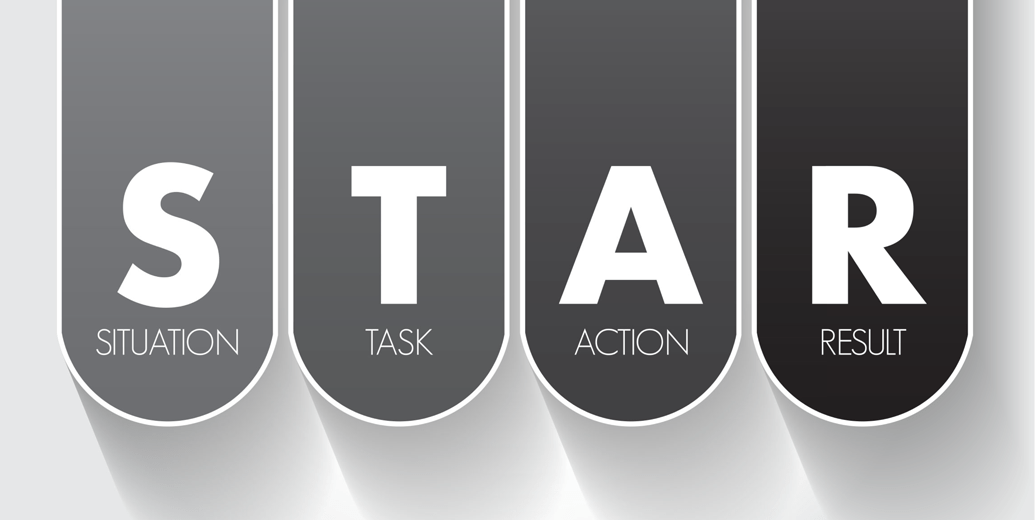
How to Interview like a Super STAR!

Using the STAR methodology can be an effective way of answering competency-based interview questions, and from our experience using it to frame your answers in public service interviews is a must! The idea behind the STAR methodology is that you talk about a specific example, give a good amount of context, and then really focus on finishing off by showing that what you did achieved a really positive outcome. So let’s break it down:

STAR is an acronym for Situation, Task, Action and Result


Situation

Set the context by describing a relevant situation where you applied your skills/qualities and gained your experience. It is important that you describe a specific event or situation not a generalised description. The situation that you discuss should be from a previous professional position. This is about framing your example and giving the interviews the context of the situation – try to be as specific as possible.


Task

What was YOUR specific role / job / responsibility? Describe your responsibility in the situation and what goal were you working towards to achieve.


Action

What did you do and how did you do it? Describe the steps and actions you took to address the situation. Use “I” not “we” when describing actions and be conscious that you don’t describe what the team did, keep the focus on you.


Result

Outline the result that stemmed from the actions you took. It is important that you think about how the result relates to the job you are applying for. Don’t be shy, take credit for your work and ensure your answer contains a really positive result. Even if you are talking about a difficult situation, sometimes how you overcame adversity can be a great result!


An Example Question and Answer using the STAR Methodology in an interview

Question: Can you give an example of a time when you had to clarify the needs of a stakeholder, colleague or manager? (supports productive working relationships)

Situation

Currently I work in the Business Improvement Team and we work as part of a larger division which is geographically dispersed across a range of locations so we don’t see each other face-to-face.

Task

There was a time when I had to do quite a bit of work with one of the managers of one of the teams that works alongside our team. We had to work together on important emergency management issues, however this manager began frequently calling me to ask me to do tasks that were well outside the responsibility of my role.

Action

While I was initially happy to help it began to have an impact on my own work outputs and priorities. I came up with a strategy to manage the situation where, when the manager would ask me to do a task, I would tell them the other priorities that I had for the day, which gave them an understanding of my workload and the situation improved significantly without developing into a conflict. I also kept my supervisor in the loop.

Result

The outcome ended up being really positive all round, as it turned out the manager didn’t have a good understanding of my workload due to the remote working arrangements.


CBR Recruitment can provide guidance on how to use the STAR methodology to blitz your next job interview, so please give us a call on 02 6103 7000 or email: hello@cbrrecruitment.com.au

For an in-depth guide on “Competency-based Interviews” please refer to our blog Competency Based Interviewing – What is it and why use it?


Categories
Candidate

6 Things You Really Should Include in Your Resume – and why…

Your resume should be brief and concise – a long, wordy resume will put off someone who is already short on time. The purpose of your resume is to summarise your experience, knowledge and accomplishments and it should be no longer than three pages. Try to tell the employer exactly what you mean using the least possible amount of words. It’s important to firstly include the appropriate content, including:


Contact Details

Your name, address, telephone, and email address should all go at the top of your resume. Choose an email address that sounds professional, and do not mention personal characteristics such as age, height, and marital status.


Objective or Summary

An objective simply tells employers the type of work you want and should be kept short. Be specific about the job you want. For example: to obtain an entry-level position within a financial institution requiring strong analytical and organisational skills. Tailor your objective to each employer you target and every job you apply for.


Education

New graduates without a lot of work experience should list their educational information first. If you have extensive relevant work experience you can list it after the work experience section. Your most recent educational information should be listed first, and include your degree, major, institution attended and minor/concentration. Also don’t forget to mention academic honours.


Work Experience

Briefly give the employer an overview of work experience that has taught you skills. Include your work experience in reverse chronological order. Make the most of your experience – potential employers need to know what you have accomplished to have an idea of what you can do for them. You should include the title of position, the name of organisation. location of work, dates of employment, and a description of your work responsibilities with emphasis on specific skills and achievements.


Other Information

Employers always want an insight into you as a person, particularly as you may have shared interests. You may want to add extra information at this point, such as key skills or competencies, leadership experience, volunteer work or participation in sporting activities or hobbies.


Referees

Always ask people if they are willing to act as a referee for you before you give their name to a potential employer. CBR Recruitment will always obtain your express permission to contact your referees so that you can give them advance warning they will be contacted.


Overall, when writing your resume don’t be vague in your explanations – describe tasks/responsibilities that can be measured objectively. Employers will feel more comfortable employing you if they can verify your accomplishments. It is also important to be honest. A falsified resume is easily spotted by an employer, if not immediately then during the interview process. To discuss your next career opportunity, please call CBR Recruitment on 02 6103 7000 or email: hello@CBRrecruitment.com.au